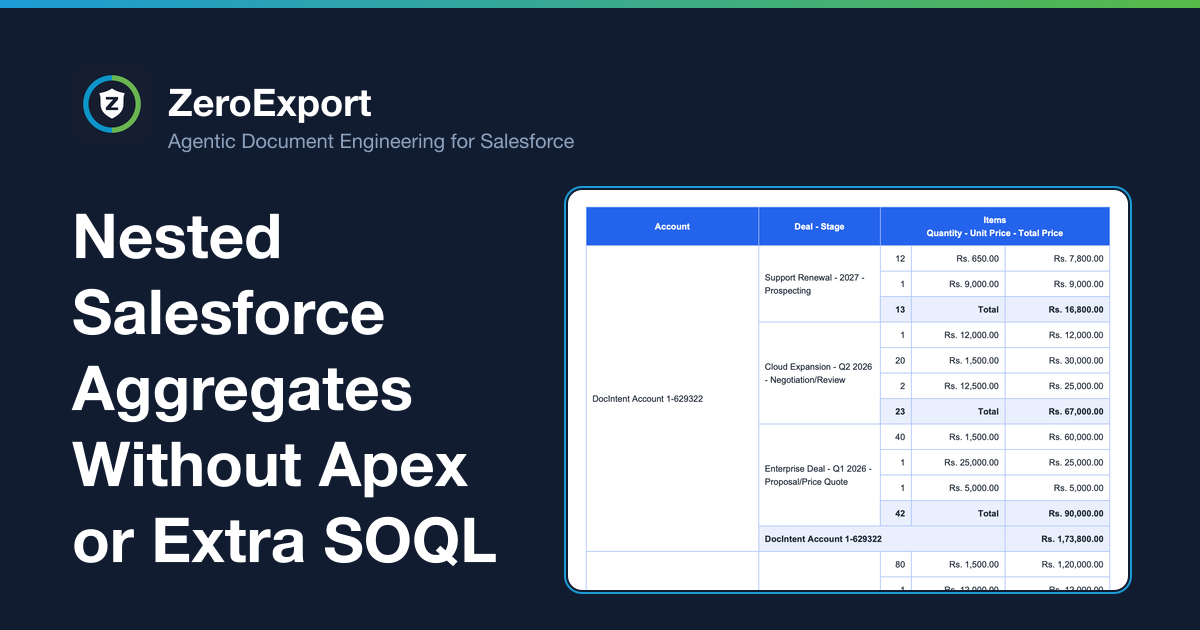
Nested Salesforce Aggregates Without Apex or Extra SOQL
Calculate scoped SUM, COUNT, and AVG values across Salesforce record hierarchies up to five levels deep—without extra SOQL queries, Apex Map code, or Word XML formulas.
38 posts tagged with “zeroexport”
Calculate scoped SUM, COUNT, and AVG values across Salesforce record hierarchies up to five levels deep—without extra SOQL queries, Apex Map code, or Word XML formulas.
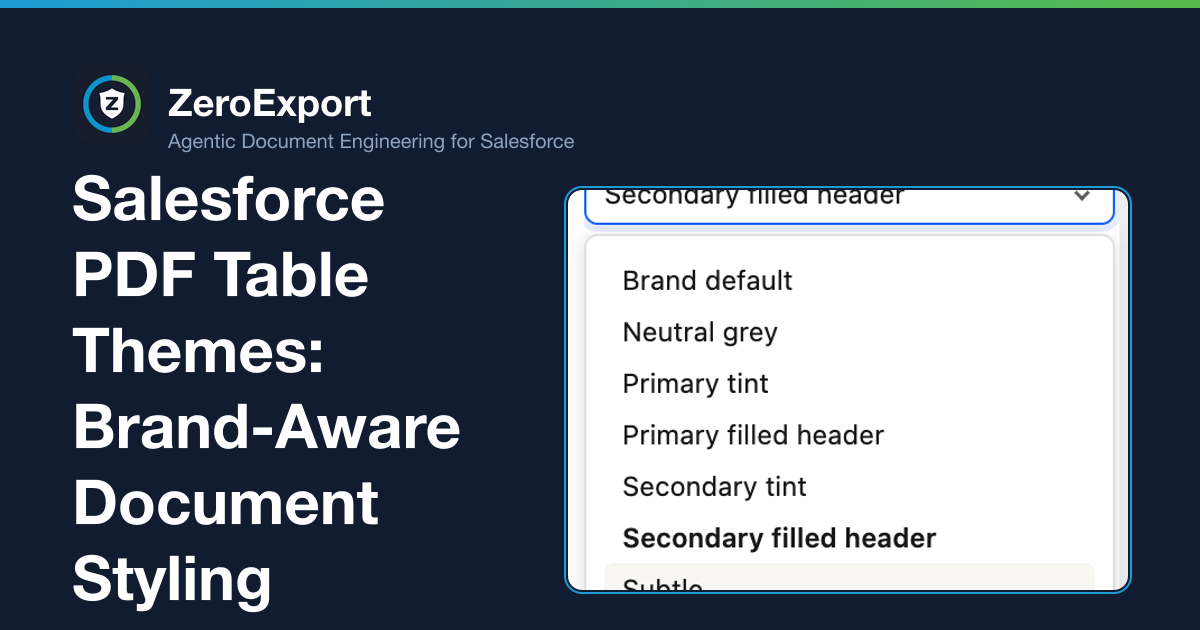
Style tables in Salesforce-generated PDFs with brand colors, seven table themes, subtotal and total row roles, empty-row hiding, and custom row colors.
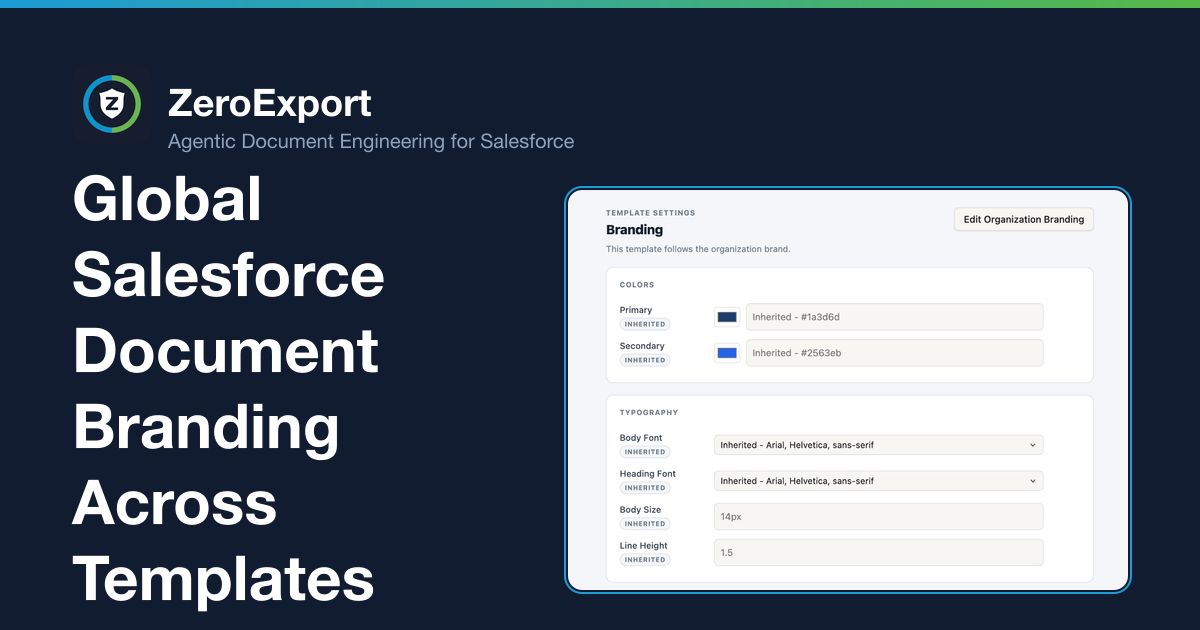
Learn how global, template-level, and inline styles control Salesforce document branding, and why templates must be recompiled after brand changes.
Learn how Salesforce admins govern record-level document edits with permissions, locked sections, read-only content, and controls that protect master templates.
Measure Salesforce document generation maintenance costs, including consultant fees, admin hours, template rework, change delays, and document-only customizations.
ZeroExport infers which table rows repeat, and where each group ends, from the merge fields in the row. See how that replaces start/end loop tags in Salesforce document templates.
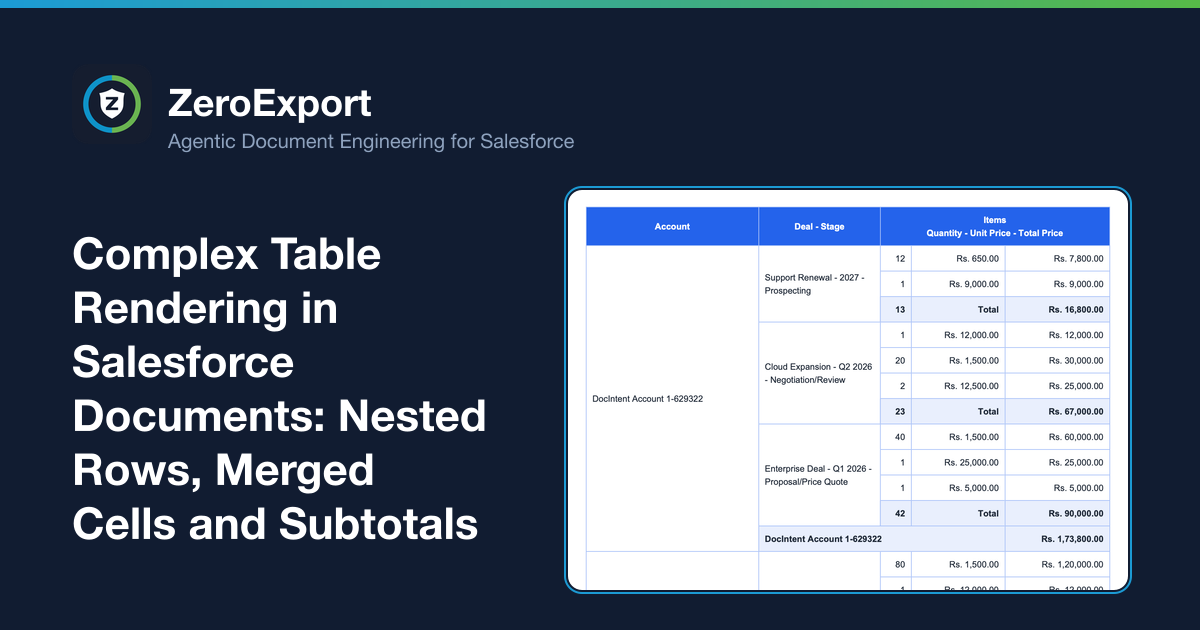
Why nested tables, vertically merged cells and multi-level subtotals break in most Salesforce document generation tools, and how compiling the table geometry before rendering keeps them intact.
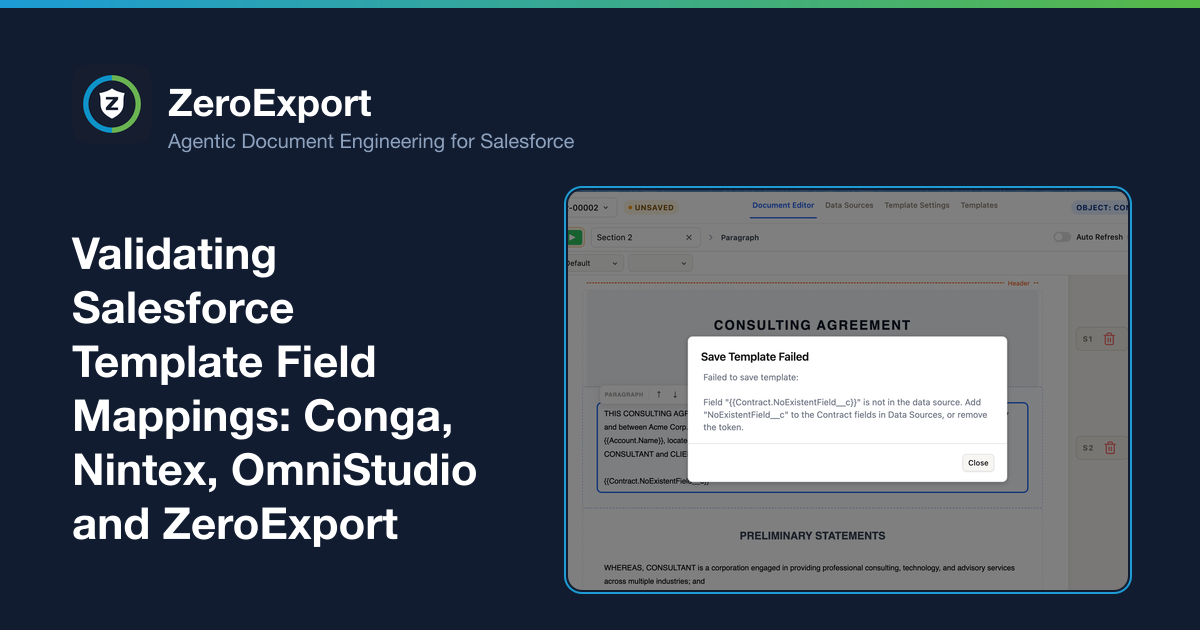
Most Salesforce document tools leave you to verify every merge field by hand, so a stale mapping prints blank in a sent document. How Conga Composer, Nintex DocGen and OmniStudio handle field mappings, and how ZeroExport validates them on every save.
Nintex DocGen assembles document packages from Word, Excel, and PowerPoint templates. Here is how that model compares to a structure-aware template, which kind of complexity each one solves, and when Nintex is the right answer.
A direct comparison of ZeroExport and Conga Composer for Salesforce document generation: the template model each one uses, how they handle nested data and silent failures, and the cases where Conga is still the right choice.
Every Salesforce docgen tool has a drag-and-drop builder now. Most of them hand you a blank canvas and a styling panel, which quietly makes the formatting your job. Here is the difference between a builder and defaults that are already right.
Visualforce renderAs="pdf" is free and already in your org. Here is the decision framework for when it is genuinely enough, when it has quietly stopped being free, and what changes if you replace it.
Building document generation in-house looks cheap for the first document. Here is the honest cost model, the four questions that decide it, and the cases where building really is the right call.
Fonts that ignore bold, logos at the wrong size, base64 images that vanish, content overlapping the header. Each Visualforce PDF formatting symptom traced to the documented limit behind it.
Salesforce only ships a native PDF generator for Quotes. Here are the four paths to generating a PDF from a custom object or any other standard object, and what each one costs.
Nested lists flatten, child-object tables lose their grouping, and images vanish when you export Salesforce data to Word. Here is why the merge model struggles with hierarchy, and when to stop using Word as the output format.
Populating a fixed PDF contract with Salesforce data works until a clause becomes conditional. Here is why the approach breaks, what dynamic really requires, and the one case where filling a PDF is still correct.
Salesforce CPQ quote templates cannot compute a monthly recurring total or subtotal a group of lines without a rollup field or a Visualforce section. Here is why, and how to get both declaratively.
Every field, flow, and object you built because your document tool could not produce the document you needed is a liability you keep paying for. Here is how to recognize docgen debt, audit how much your org carries, and stop creating more of it.
A phased migration playbook for replacing document generation in Salesforce: inventory and debt register, freeze the old system, migrate by pain, pilot with consenting users, keep a rollback path, and clean up the metadata that only existed to feed the old tool.
S-Docs already runs inside Salesforce, so the usual security and middleware arguments for switching do not apply. Here is what actually drives an S-Docs migration, what its HTML template model means for the move, and the SDoc records you must export before you uninstall.
PDF Butler splits its configuration between Salesforce records and its own service, which makes inventory easy on one side and a login-dependent exercise on the other. Here is how to plan the move: DocConfig sprawl, SOQL living in data sources, and the storage-versus-processing question a security review will ask.
What is specific about leaving Nintex DocGen: DocGen Packages that bundle several documents at once, data sources bound to reports and Visualforce pages, delivery options that are a second migration, and Apex in the loop namespace that blocks uninstall.
The unusual thing about leaving Formstack Documents is that most of what you are migrating is not in Salesforce. Here is how to inventory across both sides, export before you lose account access, rebuild delivery routing, and revoke the API credentials at the end.
Replacing Docusign Gen does not mean replacing Docusign. Here is how to move document generation while leaving your envelopes, recipient routing, and audit trail alone: the anchor tags your new template must still emit, the custom XML holding your conditional logic, and what actually comes off the bill.
What is specific about leaving Conga Composer: merge queries holding undocumented business logic, button parameter strings that are the real spec, solution sprawl, and the Salesforce metadata that only ever existed to feed a merge.
Manufacturing quotes carry bundles, options, and multi-level product structures that flat templates flatten. Here is why manufacturers hit the docgen ceiling in Salesforce, and how a native, structure-aware engine renders configured products cleanly.
CPQ quote templates handle standard quotes well but resist nested product data, conditional sections, and dynamic tables. Here are the limits teams hit and how to render complex quotes cleanly.
The native Quote PDF has no logic to hide selected line items, pushing teams into checkbox hacks and rollup fields. Here is why, and how section-level conditional structure solves it cleanly.
When business rules live inside Word templates as field codes and macros, nobody can see or audit them without opening the file. Here is why that split logic is a liability, and how to keep document logic visible.
Every LWC-to-PDF path eventually funnels back through a Visualforce page and inherits its limits. Here is why, and a native way to generate the document without the round trip.
Most teams shopping for a Conga alternative are reacting to cost, maintenance, or complexity. Here is a practical checklist for evaluating replacements, and where a native, structure-aware approach fits.
Forget the feature checklist for a moment. This is a comparison by outcome: what actually happens on the day a field is missing, a new category appears, compliance language changes, or the vendor raises the price.
CSS that looks perfect in the browser silently breaks when a Visualforce page renders as PDF. Here is why it happens, the workarounds teams try, and a native approach that avoids the problem entirely.
We analyzed ~2,900 real Salesforce document-generation discussions. The most common word was not "bug" or "error": it was "workaround." Here is what teams are actually working around, and which of those problems have a structural fix.
A Word template that generates a clean document most of the time and a subtly broken one occasionally is not bad luck: it is how merge engines work. Here is the cause and a deterministic alternative.
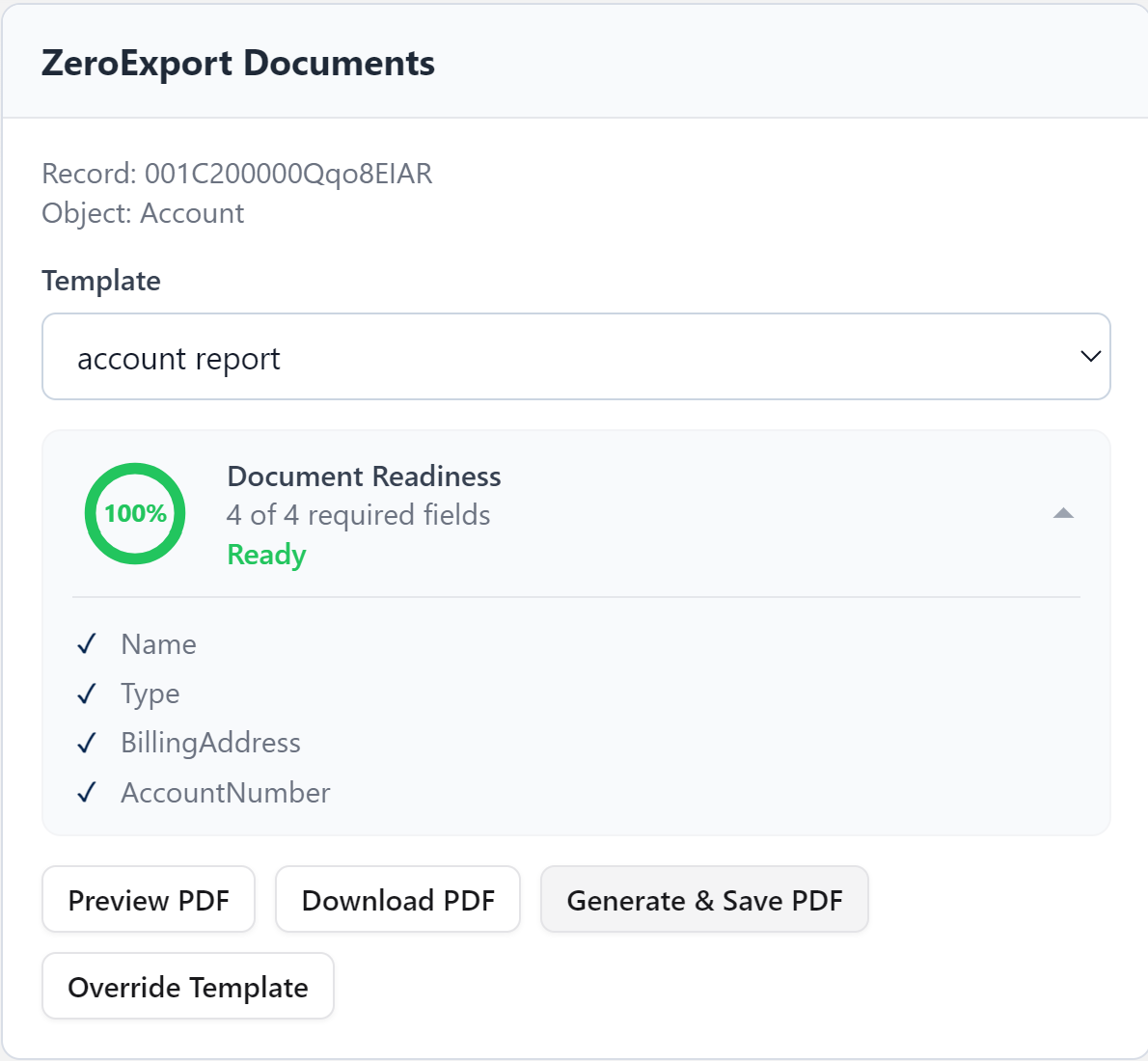
Most Salesforce document generation tools generate first and ask questions later. Document Readiness in ZeroExport surfaces missing required fields before anyone clicks Generate, directly on the record.
Build a fully branded invoice template in Salesforce using drag-and-drop sections, dynamic merge fields, PDF generation, and automation with ZeroExport.