Security Risk of Off-Platform Data Export
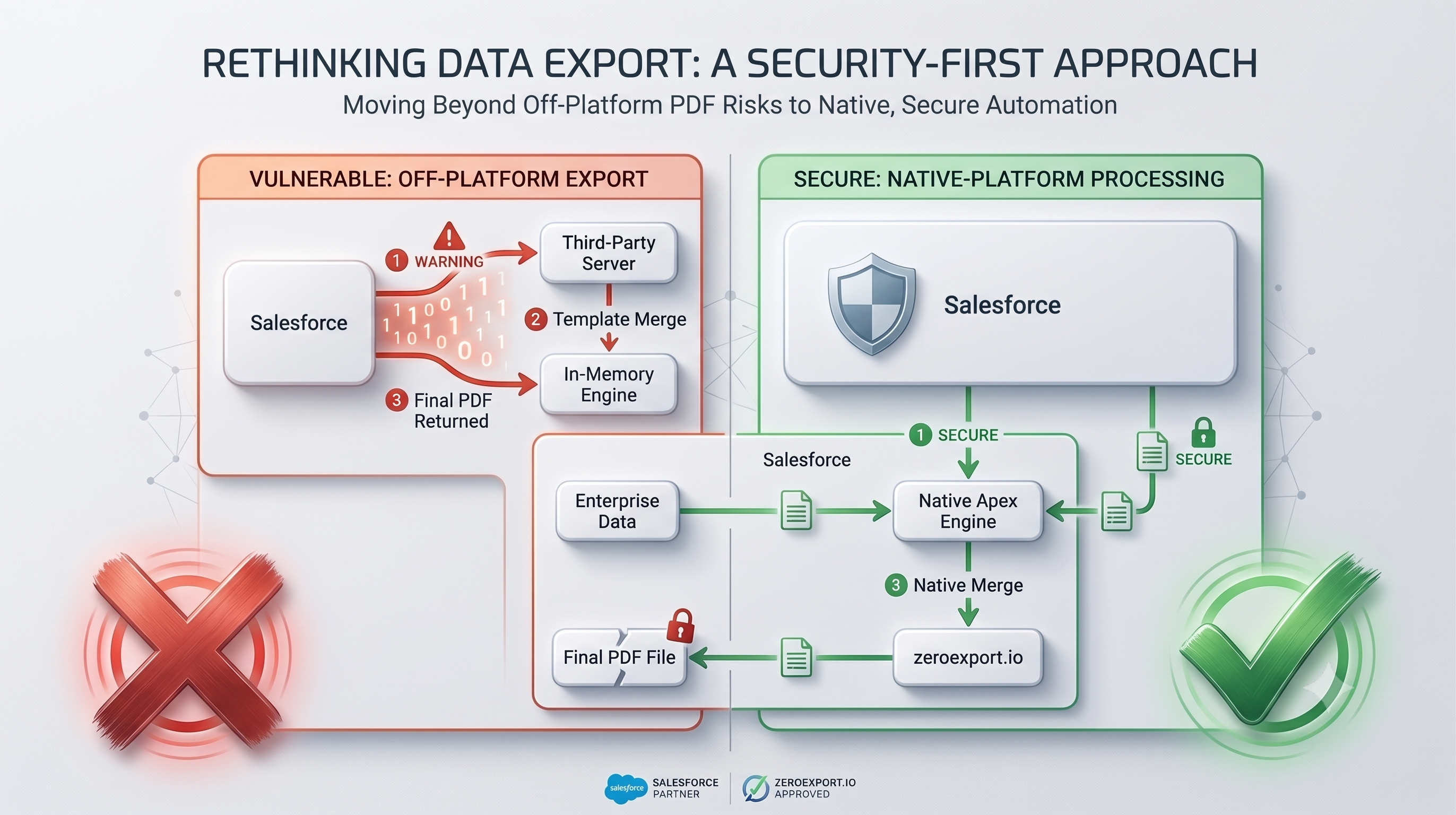
Legacy document generation tools silently export your CRM data to third-party servers. Learn how a Zero-Export Architecture keeps sensitive enterprise data fully on-platform, eliminating compliance risk and performance bottlenecks.
Introduction: The Hidden Price of "Generate PDF"
Enterprise document generation looks deceptively simple. A sales operations manager clicks a button in their CRM, and a polished quote, invoice, or portfolio review appears. However, beneath the interface of major legacy players lies an architectural reality that modern security and risk compliance teams can no longer ignore: your data is leaving the building.
Every time a proposal is built using legacy middleware, highly sensitive enterprise data is extracted, packaged, and transmitted to third-party processing servers. For heavily regulated industries like Financial Services (FinServ) and Industrial Manufacturing, this hidden data pipeline introduces significant compliance hurdles, increased latency, and a widened attack surface. If you are building a compliance case internally, why native Salesforce document generation matters for compliance is worth reading alongside this.
1. Anatomy of an Export: How Legacy Document Generation Works
To understand the security vulnerability, you must look at the data transaction path of traditional cloud-hybrid document processors:
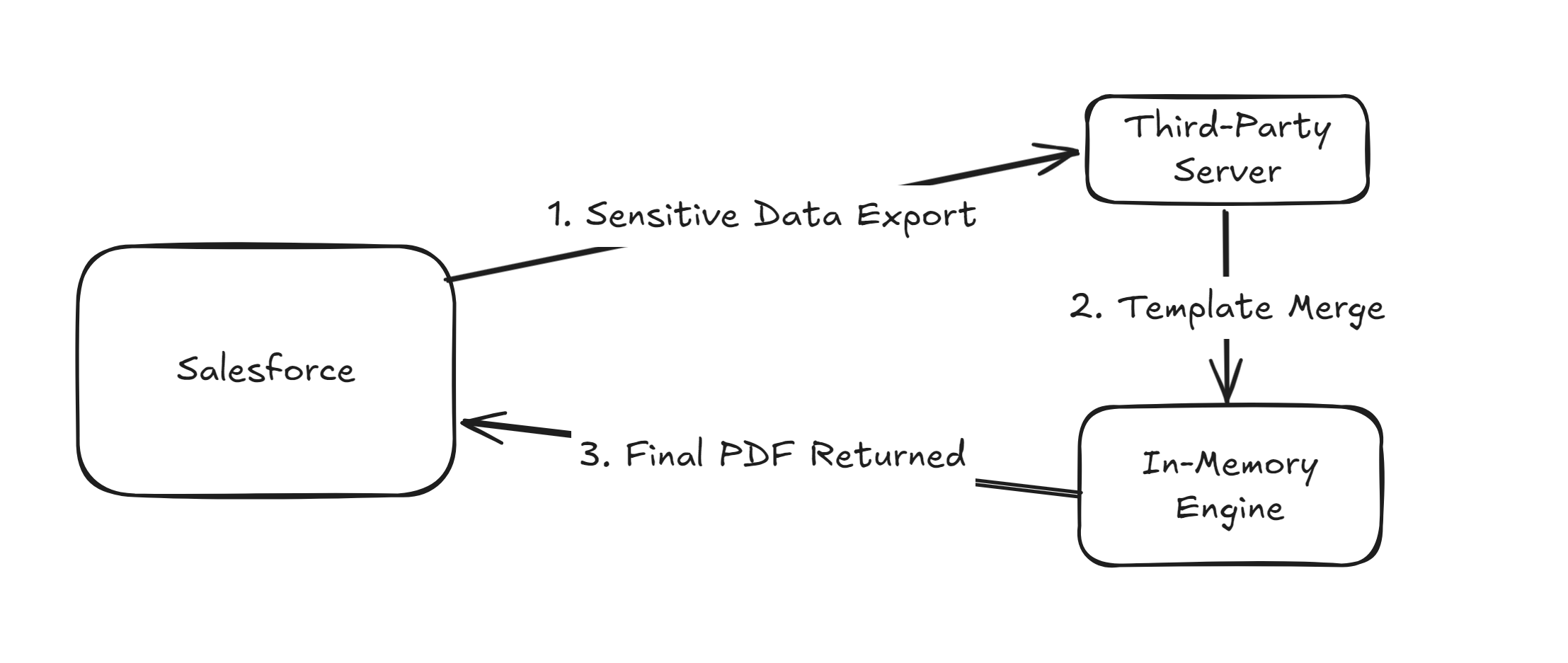
- The Extraction & Transit: The application executes complex queries across your object architecture, extracting customer names, contract values, proprietary product configurations, or financial asset data. This data is sent across the open web via HTTPS to an external server infrastructure managed by the vendor.
- The Processing Loop: The vendor's external servers open a stored file (like a Microsoft Word or Excel template), map the raw fields, execute styling rules, and render a flattened PDF document.
- The Cleanup: The final PDF is sent back to your CRM storage. While top-tier vendors process this strictly in-memory and quickly wipe the data cache, the temporary movement and external processing of raw text data itself creates a distinct compliance footprint.
2. The High Cost of Outbound Pipelines in Regulated Verticals
Financial Services (FinServ)
- The Vulnerability: Wealth management reports, institutional loan agreements, and Know Your Customer (KYC) disclosures contain highly protected non-public personal information (NPI) and granular transaction histories.
- The Compliance Friction: Sending this data off-platform triggers extensive vendor risk assessments, data protection agreements (DPAs), and potential friction with strict sovereignty and security frameworks like SEC Rule 17a-4, GDPR, or NYDFS.
Industrial Manufacturing
- The Vulnerability: Enterprise pricing proposals in manufacturing do not just show final numbers: they are built directly on top of proprietary Bills of Materials (BOMs), nested custom engineering labor hours, and multi-tiered component discounts.
- The Competitive Risk: This represents a company's core intellectual property. Moving detailed product formulas or custom component layouts to external cloud environments introduces unnecessary risk vectors for industrial espionage or data leakage.
3. Beyond Security: The Technical Performance Bottleneck
Security is only half the problem. When handling complex, deeply nested hierarchical data, such as a 5-level deep manufacturing configuration or a multi-household financial asset bundle, legacy architectures experience a performance degradation known as the abstraction bottleneck.
- The Query Loop Inflation: To pass a 5-level deep data structure to an external cloud server, legacy systems must run nested queries, construct massive payloads, and pass extensive arrays over the network.
- The Formatting Fragility: If a network blip occurs during transit, or if a single data variable in a complex table mapping fails to serialize correctly across the external API, the entire generation process crashes, leaving the user with a broken interface or a timeout error. This fragility is compounded when teams rely on Word-based merge templates, a problem explored in depth in replacing fragile Word templates with logic-driven documents.
4. The Zero-Export Architecture: True On-Platform Document Generation
The modern solution rejects the extraction model entirely. A Zero-Export Architecture (like the framework powering zeroexport.io) executes the entire assembly line inside your primary cloud container.
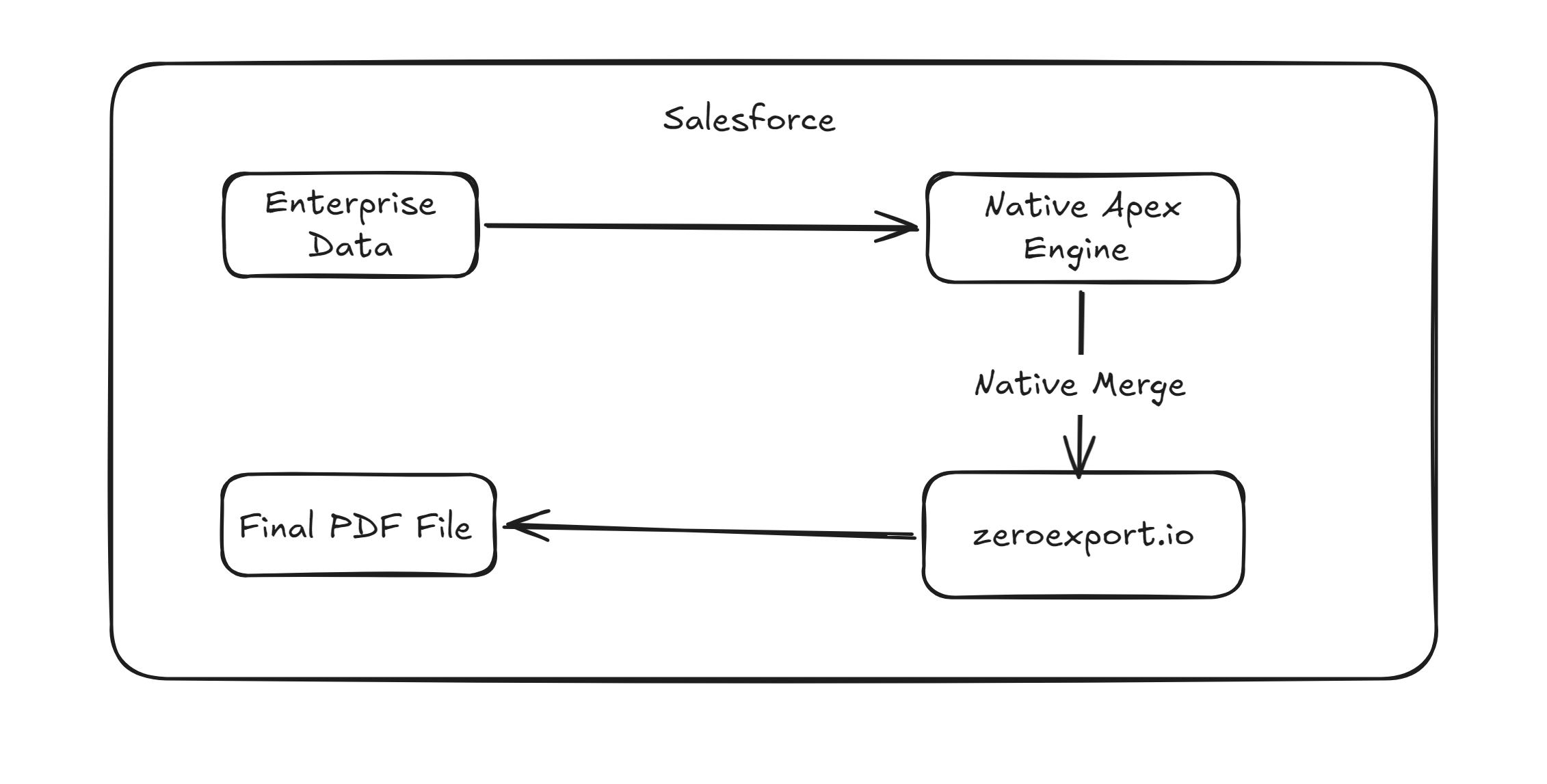
By leveraging native computing power (such as native Apex processing and modern JavaScript layout libraries inside Salesforce), the document engine comes directly to the data, rather than hauling the data out to an engine.
- Zero Outbound Data Footprint: Not a single byte of customer info, transaction history, or proprietary part numbering ever hits an external network.
- Local Retrieval, No Network Hop: Because data fetching occurs entirely on the platform's local data layer, nested hierarchies are compiled, nested, and formatted without a network round trip and without the serialization failures that come with one. We publish no throughput benchmarks, and rendering still runs inside the platform's own governor limits: evaluate against your own volumes.
- Compliance Inherent: Because the app lives entirely inside your pre-approved CRM cloud infrastructure, it automatically inherits the existing security perimeter, encryption keys, user permission sets, and compliance badges of your core ecosystem.
For a practical walkthrough of how this works end-to-end, see getting started with ZeroExport and modern document generation for Salesforce.
Conclusion: Securing the Last Mile of Workflow Automation
As businesses scale their automation, document generation can no longer remain an exceptional use case exempted from strict data perimeter boundaries. The future of enterprise workflow automation belongs to zero-export architectures. By keeping processing fully on-platform, enterprises protect their intellectual property, streamline their compliance approvals, and eliminate the architectural gymnastics required to keep data secure.
Ready to go further? Learn how to build maintainable document workflows in Salesforce that scale with your business, or see how Agentforce can trigger on-platform document generation directly from a natural language prompt.
Frequently Asked Questions
What is a Zero-Export Architecture for document generation? A Zero-Export Architecture is an approach where all document assembly (data retrieval, template merging, and PDF rendering) occurs entirely inside your CRM platform (such as Salesforce) without ever transmitting raw data to an external third-party server. This eliminates off-platform data exposure by design.
Why is legacy document generation a compliance risk? Tools like Conga or Nintex extract CRM data and send it to vendor-managed cloud servers for processing. This off-platform data movement creates a compliance footprint that triggers vendor risk assessments, Data Processing Agreements (DPAs), and potential violations of frameworks like GDPR, SEC Rule 17a-4, and NYDFS, even when the vendor processes data in-memory.
How does on-platform document generation work in Salesforce? On-platform generation uses native Salesforce capabilities, Apex classes for server-side logic and Lightning Web Components (LWC) for layout rendering, to query, merge, and convert data into a PDF entirely within the Salesforce trust boundary. No data ever leaves the org.
What regulated industries benefit most from Zero-Export document generation? Financial Services (wealth management, lending, KYC compliance) and Industrial Manufacturing (BOM-based quoting, engineering proposals) face the highest risk from off-platform data pipelines. Both handle either protected personal financial data or proprietary intellectual property that must not traverse third-party infrastructure.
What performance advantages does on-platform document generation offer? Because data retrieval and rendering happen on the same local data layer, there is no network round-trip overhead. Complex nested data structures, such as multi-level product configurations or multi-account financial bundles, compile significantly faster, and there is no risk of generation failure from external API timeouts or serialization errors.
How does Zero-Export architecture handle Salesforce governor limits for complex documents? A well-designed Zero-Export engine uses bulkified SOQL queries, collection-based data assembly, and chunked rendering to stay within Salesforce Apex governor limits, even for deeply nested hierarchies. Unlike external APIs that receive one giant payload, native Apex can incrementally build the document structure across multiple efficient query passes.
Is a Zero-Export Salesforce document tool easier to get approved by enterprise IT security? Yes. Because the app operates entirely within an already-approved Salesforce org, it inherits the existing security perimeter, SSO configuration, field-level security, and compliance certifications (SOC 2, ISO 27001, etc.) without requiring a separate vendor risk assessment or DPA negotiation.
Ready to try ZeroExport?
Start generating documents directly in your Salesforce org. No integrations, no setup overhead, no complexity.