Build maintainable document workflows in Salesforce with ZeroExport
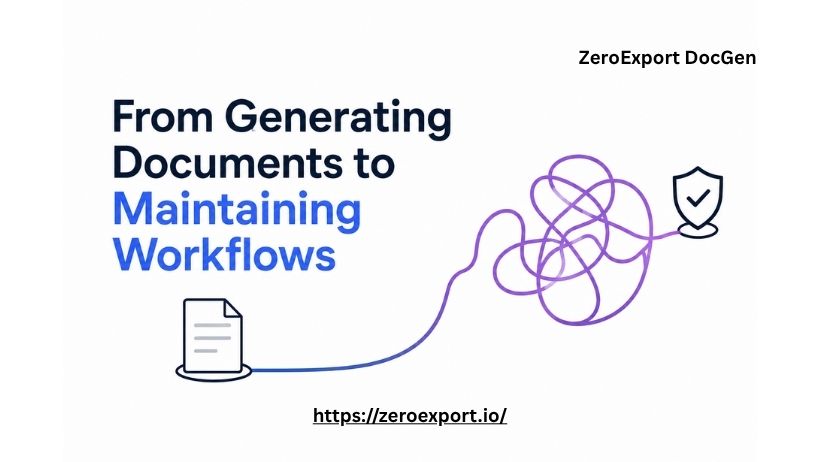
Learn how to design maintainable Salesforce document workflows that stay predictable as templates, clauses, and business rules grow in complexity.
Generating documents is easy. Keeping document workflows maintainable as your business grows is where things start to break. In this post, we explore how to build document workflows in Salesforce that are not only powerful but also maintainable and scalable.
If you are standardizing documents across teams, this broader context on CRM software can help align process decisions with your Salesforce architecture.
When Document Generation Stops Being Simple
Document generation is a considered a long solved problem for Salesforce teams. But as the business grows so document workflows grow in complexity. They become difficult to maintain. In the beginning, document generation is straight forward. You create a template, add merge fields, generate output and move on. Everyone is happy as now you have a few documents that are working.
But the business have a strange way of evolving and refusing to stay small. Very soon, your one quote template has 10 variants. Conditions are introduced. The document changes with the geographical region. Legal clauses change. Different teams want different layouts. The document generation process becomes a nightmare to maintain.
What started as "generate a document" quietly becomes "maintain document generation workflows".
The challenge is no longer creating documents. It becomes,
- What breaks if I change this field?
- What happens if I add this new clause?
- How do I know if the document will still generate?
- Why did this section disappear?
- Why did the text is flowing out of the page?
- Why the styles are not consistent across documents?
When Document Workflows Become Brittle And System Starts Guessing
Layout changes are expected. Hidden behavioral changes are not. The problem begins when a small, local edit creates side effects that only reveal themselves after document generation. This is the problem of non-deterministic document generation. When you make a change to a template, you don't know how it will impact the output until you generate the document. This leads to a lot of trial and error, and it becomes a bottleneck for teams.
We are not even talking about the use case of changing the document orientation from portrait to landscape, which is a nightmare in legacy document generation systems. The point is, as your document workflows grow in complexity, the system starts "guessing" how to handle the data and the template. This is where the real cost of legacy document generation comes in.
As a result, people start loosing confidence while making the updates to the documents. The fear comes from the fact that the document generation process is not deterministic. A simple change in a document suddenly becomes a high risk change, which requires a lot of testing and validation.
The Real Cost of Legacy Document Generation
The problem does not disappear unless the underlying system changes. Most legacy document generation systems are built around templates and merge fields that get replaced at runtime, rather than documents being constructed through predictable steps.
This approach provides flexibility, but as templates grow in complexity they become increasingly brittle. Conditions, nested sections, repeated blocks, and layout rules interact in ways that are difficult to reason about. At some point the generation engine has to interpret how the data and template should behave together.
That interpretation layer is where the real cost appears. Small changes stop feeling local, debugging becomes trial and error, and teams gradually lose confidence in making updates.
When Document Changes Become a Bottleneck
As these systems become more complex, teams often become dependent on a small group of specialists who understand how the templates behave and how to debug them. Changes that should be simple become expensive and time consuming.
Business users end up waiting for the next sprint just to add a field, update a section, or adjust a layout. Over time, document updates stop feeling like configuration work and start behaving like software projects.
This does not scale well for growing businesses. Even seemingly straightforward requests, such as changing document orientation or restructuring sections, can become disproportionately difficult in legacy systems.
Building Maintainable Document Workflows
The problem is not document generation itself. The problem is relying on systems without clear boundaries, where complexity grows faster than confidence.
Maintainable document workflows need predictability. A change should remain local. Teams should understand what a template depends on, how data flows through it, and what impact a modification will have before generating the final output.
ZeroExport approaches document generation differently. Instead of treating documents as templates where values are simply replaced at runtime, documents are built through deterministic steps. The goal is not to stop documents from naturally adapting to content, but to ensure that changes remain understandable and predictable.
When guardrails exist, teams can make updates without fear of hidden side effects, document workflows stop being a bottleneck and become something the business can evolve with confidence.
FAQ
1. What makes document workflows difficult to maintain in Salesforce as businesses grow?
As businesses grow, document workflows gain conditional logic, multiple template variations, repeated sections, approval rules, and layout changes. Small updates can start creating unexpected side effects, making teams less confident in modifying documents.
2. Why do changes in document templates sometimes create unexpected behavior?
Traditional document systems often process templates dynamically at runtime. As templates become more complex, conditions and layout rules can interact in ways that are difficult to predict, causing changes to affect areas that were not intentionally modified.
3. What is deterministic document generation?
Deterministic document generation means the document output follows defined and predictable rules. A local change produces a known impact instead of causing hidden side effects elsewhere in the workflow.
4. How can teams reduce maintenance overhead for Salesforce document generation?
Teams can reduce maintenance overhead by using structured document workflows with clear dependencies, controlled behavior, and guardrails that make template updates easier to understand and debug.
5. Why are guardrails important in document generation systems?
Guardrails help keep complexity manageable as document workflows evolve. They allow teams to make changes with confidence by ensuring flexibility does not turn into unpredictable behavior.
Related reading
Ready to try ZeroExport?
Start generating documents directly in your Salesforce org. No integrations, no setup overhead, no complexity.