Complex, High-Density Documents. Native to Salesforce.
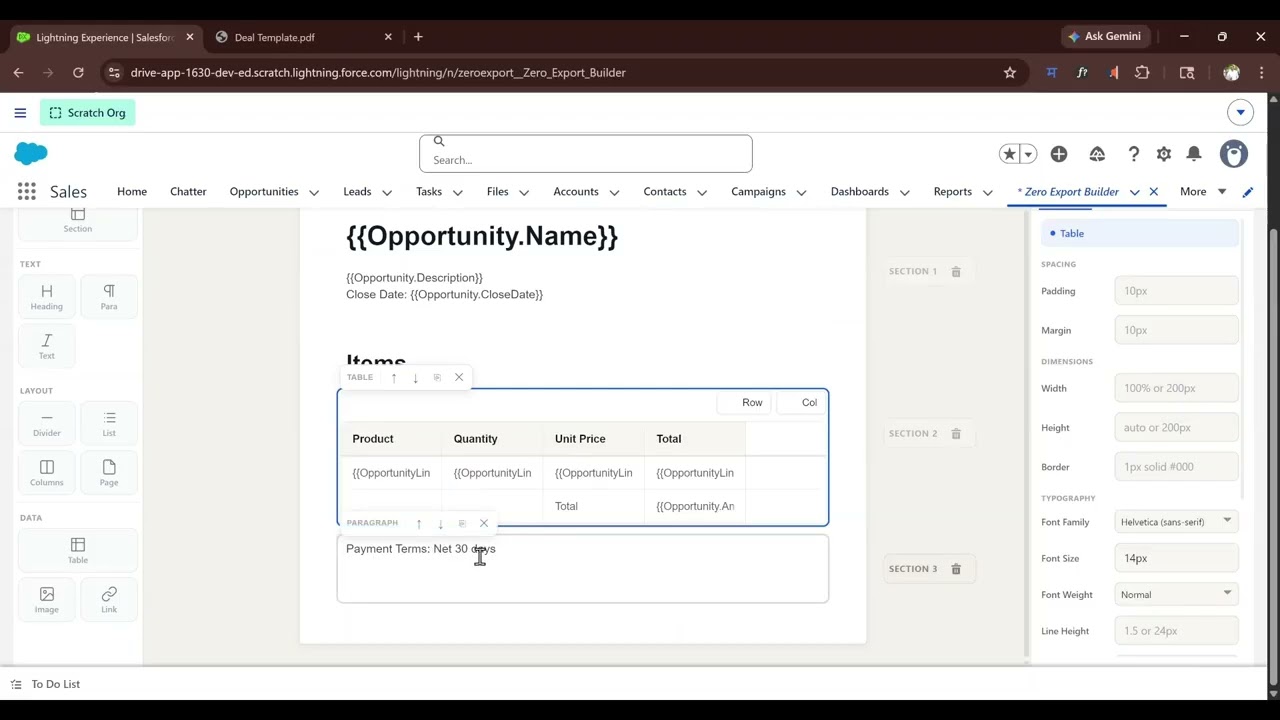
Built Inside Salesforce. Ready in Minutes.
No new apps to learn. No tabs to switch. ZeroExport works exactly where your team already works, every feature lives natively in your org.
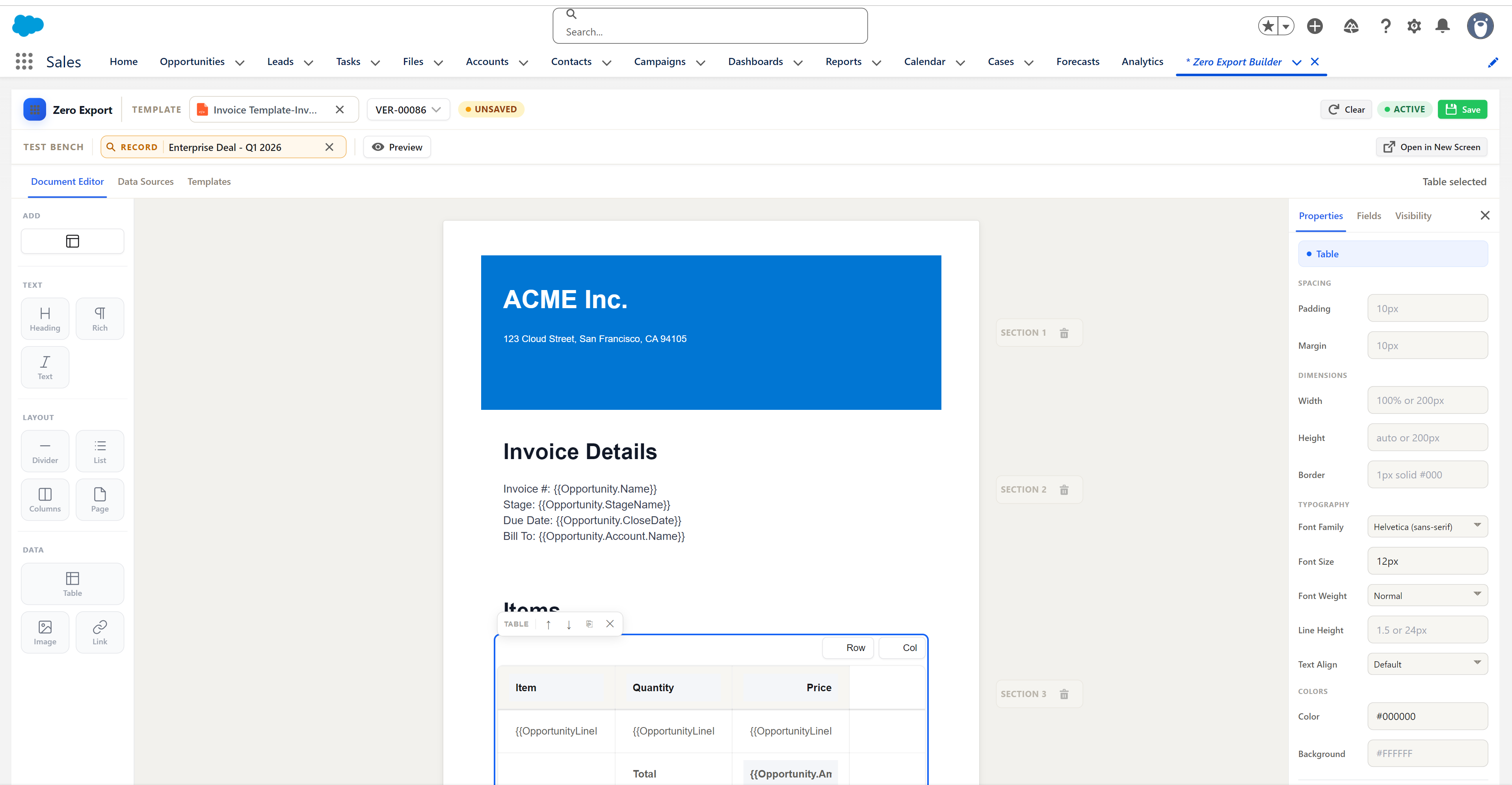
Design rich templates with sections, tables, columns, and dynamic Salesforce fields, entirely inside your org. No separate app, no context switching mid-task.
The problem, in real numbers.
We read roughly 2,900 public Salesforce document-generation discussions: Stack Exchange, Reddit, and vendor reviews. These are counts of what customers actually complained about, not our benchmarks.
Most common phrase: “workaround”
183 mentions across 156 separate threads: ahead of “better alternative”, “hard to maintain” and “keeps breaking” combined.
Word templates losing formatting
Threads where merge output was non-deterministic, the same template quietly breaking with no clear pattern.
Template maintenance & sprawl
“Every template is different.” “Impossible to maintain.” One document family, dozens of near-duplicate files.
Discussions of one legacy vendor
The most-mentioned tool in the corpus. A recurring theme across them: cost, outages and lock-in, including a pricing change that tripled one team’s annual bill.
Source: analysis of ~2,900 public Salesforce document-generation discussions (Salesforce Stack Exchange, Reddit, public vendor reviews), 2026. Stack Exchange content used under CC BY-SA.
The two pains we hear most.
Maintainability and brittle Word templates dominate the complaints. Both trace back to the same root: a flat template plus a merge engine. Change the architecture and the pain doesn't move: it disappears.
The pain
Brittle Word templates
Merge engines are non-deterministic. The same template produces a correct document most of the time and a subtly broken one occasionally, so a human reviews every batch by eye before it ships.
What ZeroExport changes
Deterministic, structure-aware rendering
AI can draft the template, but every generation after you save runs identically. A missing field reflows the layout instead of leaving a gap, and structural problems surface as a build-time warning, before a customer opens the file.
The pain
Unmaintainable template sprawl
Field-level visibility toggles push teams into one template per variant. A single compliance wording change becomes a manual sweep across dozens of files, and in real threads, some get missed.
What ZeroExport changes
One structured template, not a folder of copies
Section-level visibility cascades to everything nested inside a section, so one template carries the branching logic. Per-record override lets you edit a single document without touching the shared template.
Generating a document is easy.
Engineering one is the hard part.
Every tool on the market can merge fields into a page. That problem was solved years ago. The one that isn't: structure that holds up when the data changes, logic you can actually read and maintain, and output you can trust without inspecting it first. That is document engineering, and it is the problem ZeroExport exists to solve.
Not Built for Simple Contracts.
Built for Complex Data Trees.
If all you need is a 2-page NDA, a standard waterfall agreement, or a simple mail merge, use a free tool or legacy agreement engine. ZeroExport is not built for simple contracts.
Legacy tools are Swiss Army knives for text replacement. ZeroExport is a surgical scalpel engineered for complex data trees, nested hierarchies, and pixel-perfect layout integrity.
Red Path
Your Data
Spread across multiple systems and tools
Weeks of Setup
Integrations, API config, authentication, testing
Multiple Systems
External tools, APIs, and workflows to manage
Ongoing Maintenance
Breakages, updates, and dependency on consultants
Document
Finally generated after multiple steps
Green Path
Your Data
Stays where it already is
Install Package
Minutes, not days
Build in the LWC Grid
Map nested data visually. No Apex, no DataRaptors.
No Setup and Maintenance Overhead
No integrations. No external systems. No consultants.
Document
Generated instantly, ready to use
| Free & Open-Source Tools | Legacy Agreement Tools (Conga, Nintex) | OmniStudio DocGen | ZeroExport | |
|---|---|---|---|---|
| Best Fit | Simple contracts, 2-page NDAs, basic mail merges | Standard agreements built on Word templates | Nested documents, if you have a certified team | Complex, high-density documents: nested pricing, portfolios, BOMs |
| Nested Data | Custom Apex wrappers or SOQL loops to flatten it first | Repeat regions hand-marked inside the Word template | Supported, through DataRaptors a developer builds | Five levels deep, read straight into a visual LWC grid |
| Layout Integrity | Flat, permissive merge tags fail silently or leave blank gaps | Brittle Word XML that breaks when dynamic text length changes | Token-based templates, mapped and maintained by developers | Deterministic grid that reflows, with fail-closed validation |
| Data Sovereignty | Varies by tool | CRM data routed to external processing servers | Inside Salesforce | 100% native, zero data egress |
| Who Keeps It Running | A developer or consultant, every time a layout shifts | Consultants and template specialists, for every change | Certified OmniStudio developers, for build and every change | Your admin |
| Delivery Speed | Fast for simple documents, slow once data is nested | Days to weeks of configuration, template work, and testing | Weeks: DataRaptors, token mapping, and testing before the first document | Installed in minutes, first document the same day |
| Total Cost | Free software, paid for in ongoing developer hours | License and usage fees, plus a consultant tax on template upkeep | High TCO:licensing, certified developers, and weeks of build before any value | Flat $10,000 / org / year. No seats, no overages |
Cut Every Tool You Used to Need.
Keep Only What Matters.
Complex documents usually arrive with integrations, middleware, consultants, and custom code. ZeroExport ships without any of them.
Minutes, Not Weeks
Removes weeks of setup. Install one managed package and start generating documents the same day. No project plans, no phased rollouts, no waiting on external teams.
Nothing to Integrate
Removes APIs and middleware. No external servers, no authentication flows, no data pipelines to configure. Documents generate where your records already live.
Your Admin Runs It
Removes consultant dependency. Configure templates, manage outputs, and troubleshoot issues: all inside Salesforce. Your admin owns it end to end.
Nested Data, Five Levels Deep
Removes custom code gymnastics. Bundles inside bundles, positions inside portfolios, components inside assemblies: each level renders with its own sub-totals, with no Apex wrappers or SOQL loops to flatten it.
AI-Assisted Template Creation
Removes template guesswork. Describe what you need and AI generates the merge fields. Review and edit before saving: every generation after that is deterministic.
Structure-Aware Output
Removes silent failures. Missing data reflows the layout instead of leaving blank gaps, and validation is fail-closed: structural problems surface as a build-time warning before the document ships.
It Compounds.
Cut integrations and maintenance goes with them. Cut middleware and breakages disappear. Cut consultants and your admin is unblocked. What's left is a managed package that just works.
Complex, High-Density Document Automation
ZeroExport is built for multi-layered data structures: the documents where traditional merge tools fail or break.
Multi-Tiered Pricing Schedules
Quotes and order forms where bundles sit inside bundles and every layer carries its own sub-total. The layout follows the data tree, however deep the deal goes.
- ›Multi-tiered pricing schedules
- ›Nested bundle-inside-bundle breakdowns
- ›Sub-totals at every layer
Portfolio Summaries & Policy Schedules
Statements that walk from account to position to lot to transaction, with every level scoped to the one above it and nothing left to reconcile by hand.
- ›Comprehensive portfolio summaries
- ›Policy schedules
- ›Audit-heavy compliance reports
Nested BOMs & Spec Sheets
Bills of Materials that break assemblies into sub-assemblies and components, and technical specification sheets that stay intact when the data changes.
- ›Multi-nested Bills of Materials
- ›Complex technical specification sheets
- ›Up to five levels of nested data
Need a 2-page NDA or a simple mail merge? A free tool or legacy agreement engine will do that well. ZeroExport is for the documents those tools break on.
Ask for Documents. Get Them Instantly.
ZeroExport provides a plug-and-play add-on for Salesforce Agentforce. Turn it on, map templates once, and users can request documents in plain language instead of clicking through records.
User sends a plain-language prompt
The Agentforce agent receives the request, for example: 'generate proposals for my top 5 open opportunities'.
Agent identifies the records
Agentforce queries Salesforce to find the relevant records matching the user's description, using the current user's access and context.
ZeroExport selects the template and generates
ZeroExport identifies the correct document template for the object type, then generates PDFs using Apex inside your org: nothing leaves Salesforce.
Agent returns document links
The agent responds with links to every generated document. The user reviews, downloads, or shares: they decide what to do next.
Example prompts
“Generate invoice PDF for Acme Inc from the latest opportunity.”
Finds the most recent Opportunity for Acme Inc → applies Invoice template → returns PDF link
“Generate opportunity summary PDF for my latest 5 opportunities.”
Finds 5 most recent Opportunities owned by the user → generates 5 summary PDFs → returns all links
“Create a proposal document for all open deals closing this month.”
Queries Opportunities closing in the current period → generates proposal PDFs for each → returns links
“Generate account summary for Salesforce Inc.”
Finds the Account record → applies Account Summary template → returns PDF link
Agentforce helps users prepare documents. Users decide what to do with them.
Ask Your Documents. Right Where They Already Are.
A contract is attached to the Opportunity. The SLA is on the Account. Everyone can see the file. Nobody can ask it a question. ZeroExport Ask Agent lets Agentforce answer questions about the Word and PDF documents attached to any record, read at the moment you ask, inside your org.
It is a separate installable app under the ZeroExport umbrella, with no dependency on ZeroExport. Install it on its own.
Read live, never indexed
No ingestion step and no vector index, so there is nothing to upload, tag, or wait for. If the file was attached a minute ago, the answer reflects it. Data Cloud is not required.
Cited, and it will tell you when it does not know
Every fact is traceable to a section of a named document. Ask about something the document does not cover and it says so, and names the document it searched, instead of falling back to general knowledge.
The file never leaves Salesforce
Word documents are parsed in Apex inside your org, and PDFs are processed locally in your browser, inside the Agentforce chat. No callouts, no middleware, no stored copy. The agent reads as the user who asked, so your existing sharing rules still decide who sees what.
On an Account with an SLA attached
“What’s the target resolution for a Severity 1 issue?”
Severity 1 (Critical Outage) has a target resolution window of 4 hours, with a 15-minute first response, escalating to the VP of Engineering.
Section: 2. Targets — Enterprise_SLA_2026.docx
What ships
- Three agent actions ready to add to any Agentforce agent: read a document, list what is attached, and answer questions about the app itself.
- One permission set and nothing else. No custom objects, no scheduled jobs, no data model to learn.
Reads Word (.docx), preserving headings, tables and lists, and PDF from v0.3. Scanned or image-only files contain no text to read, and the agent says so rather than guessing.
Skip the Template Guesswork. Stay in Full Control.
AI generates a structured template draft for you to review and edit. No hunting for field API names, no building from scratch. Every generation after that runs deterministic Apex.
Describe what you need
Tell the assistant what the template is for, for example: 'an invoice for an Opportunity' or 'an offer letter from a Job Application record'.
AI builds the structure
The assistant generates a structured template using the correct merge fields for your chosen Salesforce object. No guesswork, no hunting for field API names.
You review and edit
The draft opens in the template editor. Adjust layout, add sections, change merge fields, apply branding. Nothing is saved until you approve it.
AI assists with creation: you control the final output.
Every generation is deterministic
Once saved, the template runs the same way every time using Apex inside Salesforce. No AI involved in execution: reliable, consistent, auditable.
Speed to create. Predictability to execute.
AI assists in template creation, not execution. Once a template is built and saved, ZeroExport generates documents the same way every time: no AI in the generation loop, no unpredictable outputs.
Two plans. One flat price.
No seat taxes, no overage billing, zero consultant dependencies.
Free
Full document generation on three templates, with no time limit. Put your hardest documents through it.
- 3 active templates
- Full document generation
- Runs inside Salesforce, no middleware
- Self-serve and email support
- –Agentforce integration
- –AI-assisted template creation
Enterprise
One flat price for the whole org. No seats to count, no usage to meter.
- Unlimited templates
- Unlimited users
- Deep nested data trees
- Agentforce integration
- AI-assisted template creation
- Runs inside Salesforce, no middleware
- Priority support
No seat taxes
Unlimited users on one org-wide price
No overage billing
No per-document or usage fees
Zero consultant dependencies
Your admin builds and runs it
Different Approach, Not Just Different Features.
Most document tools are built around integrations and external workflows. ZeroExport is built to remove them. The difference is not a score on a chart: it is an entirely different architecture.
External Tools
Conga, Nintex, custom integrations
- Require integrations and API configuration
- Route CRM data to external servers to process documents
- Need ongoing maintenance: token refreshes, version updates, breakages
- Often require consultants for setup and changes
- Price per seat, per document, or per use, so cost scales with you
ZeroExport
Managed package, nothing else
- No integrations to build or maintain
- 100% native to Salesforce: zero data egress
- Nothing external means nothing to maintain
- Your admin configures and manages it directly
- Flat annual price per org: no seat taxes, no overage billing
Built on Structure, Not Placeholders.
Other tools merge data into a flat layout. ZeroExport understands the structure of your document, which means it can adapt when data is missing, not just when it is present.
External Tools
Flat merge-tag engines, free or licensed
- Template is a flat layout with placeholders; the engine merges data into it
- Missing data leaves blank boxes, dead column space, or broken layouts
- Nested data has to be flattened first, with custom Apex or SOQL loops
- A misplaced tag or deleted field fails silently, found by a customer, not by you
ZeroExport
Structure-aware document engine
- Template understands structure, not just placement
- Missing data collapses the layout automatically: nothing left half-empty
- Nested hierarchies render directly, up to five levels deep
- Structural problems surface as a build-time warning, not a production incident
Stop Managing Document Workflows.
Let ZeroExport Handle It.
Generate pricing schedules, portfolio summaries, and nested BOMs entirely inside Salesforce. No external tools to manage. No setup to maintain. No coding required.
Manual Data Export
Stop copying Salesforce records into Word or Excel templates by hand. ZeroExport reads directly from your objects: no export, no paste, no formatting errors.
Key Features:
No data export required
No copy-paste errors
All data stays in Salesforce
One click from any record
Third-Party Integration Management
No middleware, no API keys, no webhook debugging. ZeroExport runs inside Salesforce as a managed package: nothing to connect, nothing to break.
Key Features:
No API keys to manage
No middleware to configure
No vendor dependencies
No integration failures
Consultant-Dependent Maintenance
Your admin configures it once. No ongoing support contracts, no consultants to call when something breaks, no upgrade cycles to survive.
Key Features:
Admin-configurable, no code
No ongoing support required
No upgrade cycles
Works from day one
All Documents. Zero Complexity.
Stop Managing Integrations. Start Generating Documents.
Zero APIs to configure
Go live in minutes, not weeks
Runs entirely inside Salesforce
Cut the Complexity. Keep the Documents.
No integrations to build, no middleware to maintain, no consultants to hire. Install one package, configure your templates, and your admin runs it from there.
✨ No spam, ever. Updates only when we have something meaningful to share.
🔒Your information is secure. We'll only contact you about your ZeroExport installation.